
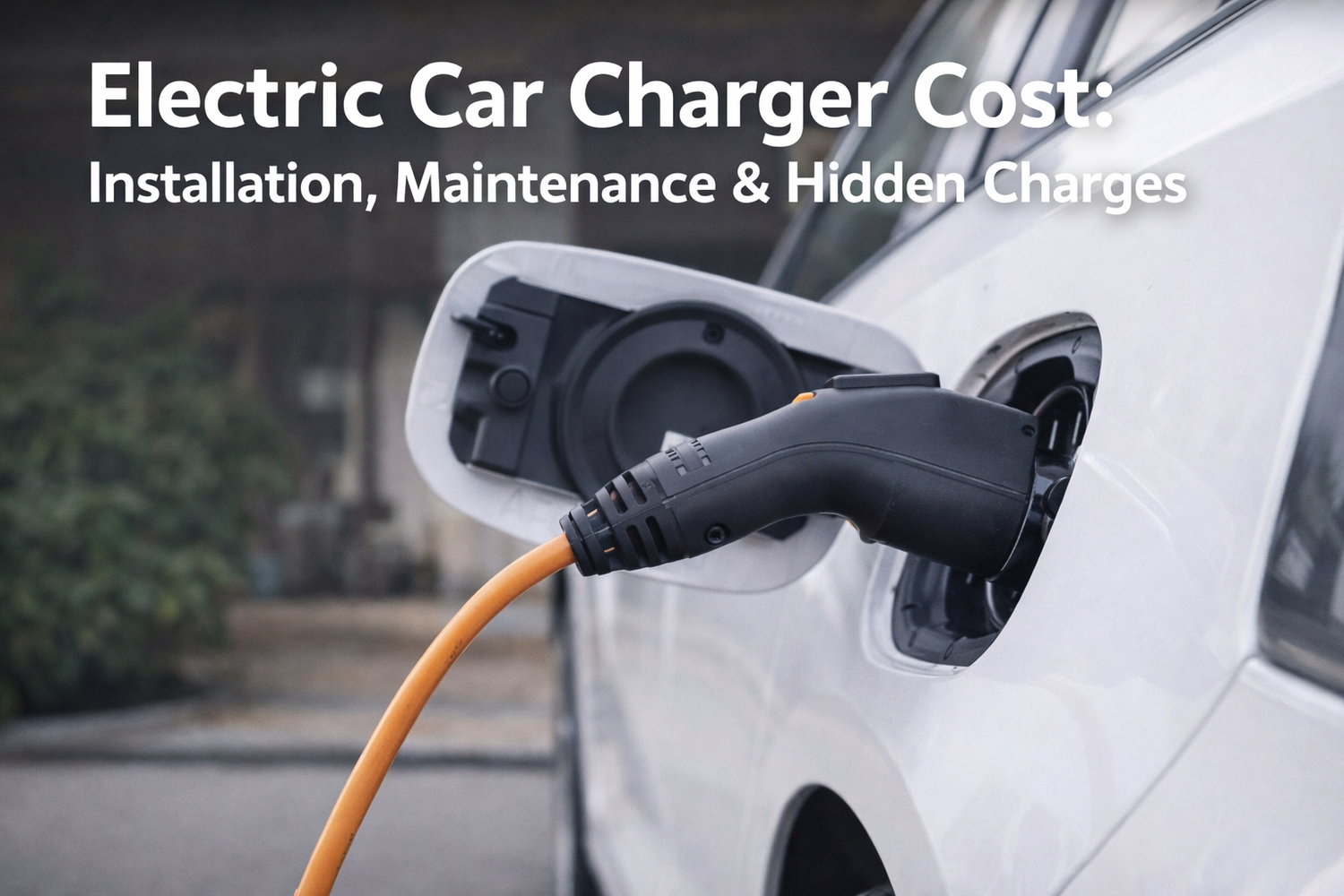
Switching to an electric vehicle feels like a smart financial move, lower running costs, minimal engine maintenance, and government incentives making the transition easier than ever. But there is one cost that quietly catches most new EV owners off guard: building a reliable home charging setup. Between the equipment, installation, ongoing maintenance, and the charges nobody mentions upfront, the final bill can look very different from what you anticipated.
Here is a clear, honest breakdown of what you are actually paying for and where smarter choices can save you a significant amount of money.
The Equipment Cost: Where It All Begins
What Comes With Your Car Is Rarely Enough
Most EVs sold in India come bundled with a basic 3.3 kW portable charger from the manufacturer. On paper, this sounds sufficient. In practice, it takes anywhere from 10 to 14 hours to fully charge a mid-range EV battery which means plugging in before bed and hoping for the best. For occasional backup use, it works. For daily charging, it is a frustration waiting to happen.
Upgrading to a Level 2 Home Charger
The practical upgrade for most homeowners is a Level 2 AC wall charger in the 7 kW to 11 kW range. This brings charging time down to 4 to 8 hours depending on your vehicle's onboard charger capacity, meaning a full charge is ready by morning with room to spare.
In India, a quality wall charger from a reputable brand costs between ₹12,000 and ₹35,000 depending on power output and smart features. This is where brands like ORBLR DRIVTECH stand out. Their CYBR7 (7.4 kW, single phase) and CYBR11 (11 kW, three phase) wall chargers include app-based scheduling, RFID access control, IP65 weatherproofing, and adjustable current output at pricing that sits well below what dealership-arranged packages typically charge for comparable or lesser specifications. You can explore their full home charger range on ORBLR's website to compare models and pricing directly.
Installation Cost: The Variable Nobody Warns You About
Why No Two Installations Cost the Same
Installation is where EV charging budgets become unpredictable. A straightforward setup where your parking spot is close to the meter panel and the existing wiring is adequate might cost as little as ₹3,000 to ₹6,000. But most homes, particularly urban apartments and older independent houses, are not that straightforward.
According to the Bureau of Energy Efficiency, which governs EV charging standards and safety norms in India, home charger installation costs can range from ₹3,000 on the simpler end to ₹35,000 or more for complex setups requiring significant electrical work.
Factors That Push Installation Costs Higher
Several variables determine where on that range your installation lands. The distance between your parking spot and the main electrical panel is often the biggest factor longer cable runs mean more material and labour. Whether your home needs a dedicated circuit added, the existing electrical load capacity, the requirement for civil work like conduit laying or wall drilling, and in apartment complexes, the need for housing society approvals all of these add time, complexity, and cost.
The Dealership Bundling Problem
Dealerships tend to bundle installation costs opaquely into a single package price, making it impossible to see what you are paying for the charger versus the labour versus the installer's margin. Buying directly from a manufacturer like ORBLR, which provides a pre-installation home survey by a certified technician before any invoice is raised, gives you a transparent cost breakdown and eliminates unpleasant surprises.
Maintenance Costs: Lower Than You Think, But Not Zero
The Good News First
One of the genuine advantages of EV chargers over traditional fuel infrastructure is the near absence of mechanical maintenance. There are no filters, no fluids, no combustion components. A well-built wall charger, properly installed, can run for years without needing any attention at all.
What Can Still Go Wrong
That said, maintenance is not entirely absent, and ignoring it is how small issues become expensive ones. Cable and connector wear is the most common problem over time particularly with portable chargers that are plugged and unplugged daily. Surge damage from grid fluctuations, a real and frequent concern across many Indian cities, can affect internal circuitry if the charger lacks adequate protection. According to Electrical India, voltage fluctuation remains one of the top causes of premature EV charger failure in the country, making surge protection a non-negotiable feature rather than an optional add-on.
Why Warranty Terms Matter More Than You Think
Smart chargers also require periodic firmware updates to stay compatible with evolving EV software standards, a factor that cheap or generic chargers simply cannot support. Choosing a charger with a strong warranty significantly reduces your long-term maintenance risk. ORBLR's wall charger range comes with a 2-year warranty on all parts and a 5-year warranty on the cable and enclosure, the two components most likely to show wear under daily use.
Hidden Charges: The Costs Nobody Puts in the Brochure
Electricity Tariff Slab Creep
The most financially significant hidden cost is one that most buyers never consider at the time of purchase. In India, residential electricity is billed in consumption slabs the more units you consume per month, the higher your per-unit rate, and that higher rate applies to your entire bill, not just the excess. Adding EV charging to your monthly consumption can push you into a higher tariff bracket, effectively increasing what you pay for lighting, appliances, and everything else.
The fix is straightforward: use a smart charger that supports off-peak scheduling. ORBLR's EVO7+ and CYBR series both support app-based scheduling through the SmartLife platform, letting you shift charging to late-night hours when grid demand and applicable tariffs are lower.
Apartment and Society Charges
In gated communities and apartment complexes, dedicated EV charging point approvals sometimes come with associated charges whether for dedicated meter installation, building wiring modifications, or society-levied infrastructure fees. The Ministry of Power has issued guidelines directing housing societies to facilitate EV charging installation for residents, but on-ground compliance remains inconsistent and negotiating these approvals takes time.
Electrical Infrastructure Upgrades
Older homes may require meter board upgrades, additional earthing installation, or higher-capacity MCBs before a 7 kW or 11 kW charger can safely operate. These are legitimate electrical requirements, not upsells — but they are costs that a pre-installation survey will surface before you've spent anything.
What a Realistic Budget Looks Like
Putting the Numbers Together
A practical total budget for a complete home EV charging setup in India covering equipment, installation, and a buffer for electrical groundwork realistically falls between ₹20,000 and ₹55,000 depending on your home's specific conditions and the charger you choose.
Making the Smarter Choice
Buying your charger directly from a certified manufacturer rather than through a dealership is the single most effective way to reduce that number without compromising on quality or features. ORBLR DRIVTECH offers smart, warranty-backed home EV chargers built for Indian conditions at transparent prices, with installation support that doesn't hide costs inside a bundle.
The Society of Manufacturers of Electric Vehicles has consistently encouraged EV buyers to treat charging infrastructure as a considered, researched purchase rather than a dealership afterthought. That advice is worth acting on. The charger you install today will be in daily use for the next five to ten years. It deserves the same attention you gave to choosing the car.


Leave a comment
This site is protected by hCaptcha and the hCaptcha Privacy Policy and Terms of Service apply.